Enterprise AI: A Strategy for Modernising Internal Banking Processes
I led the discovery and define phase for an AI initiative for a large universal bank, identifying where AI could meaningfully transform daily processes, assisting with high-volume information processing, and increasing employee satisfaction.
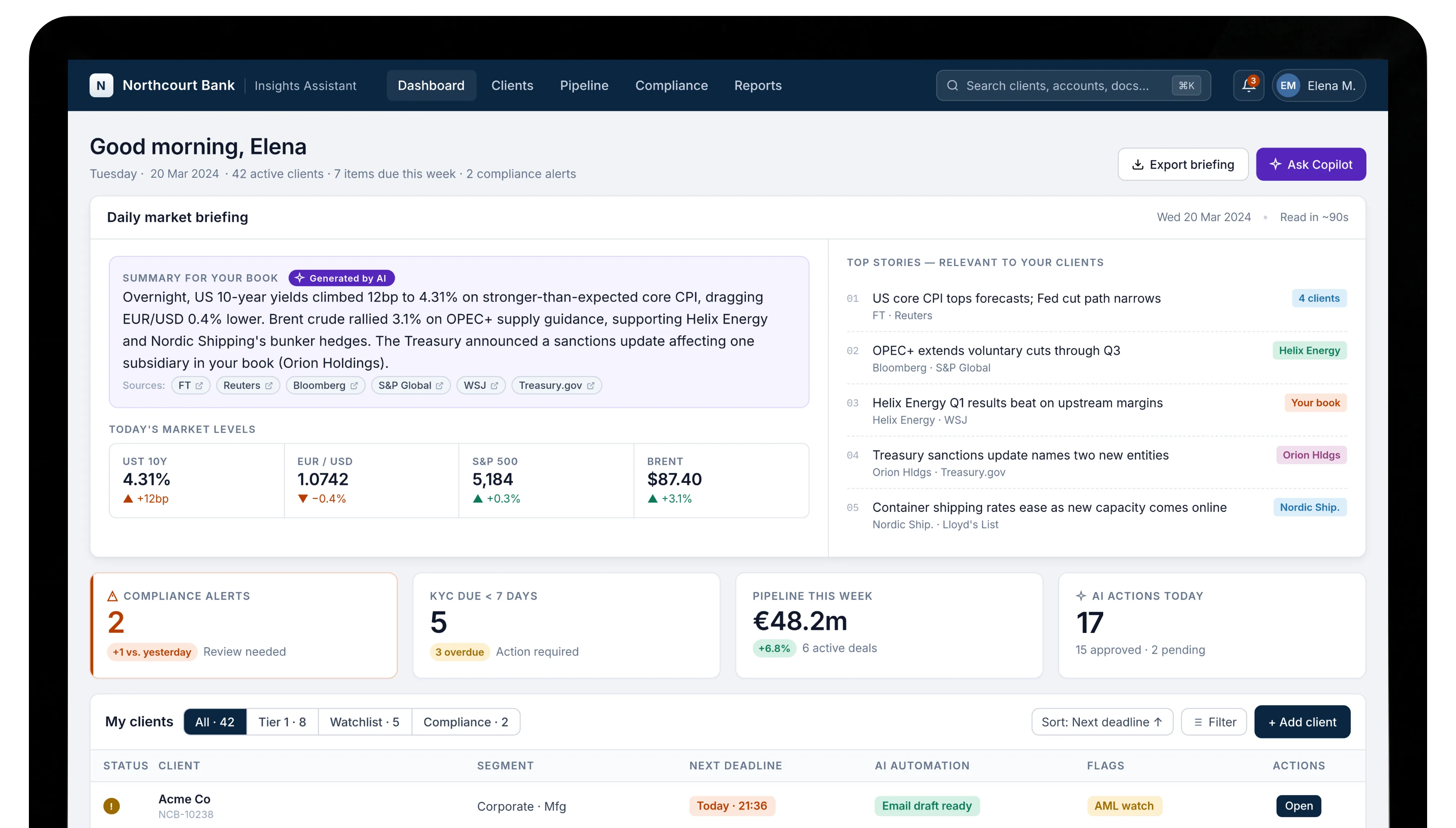
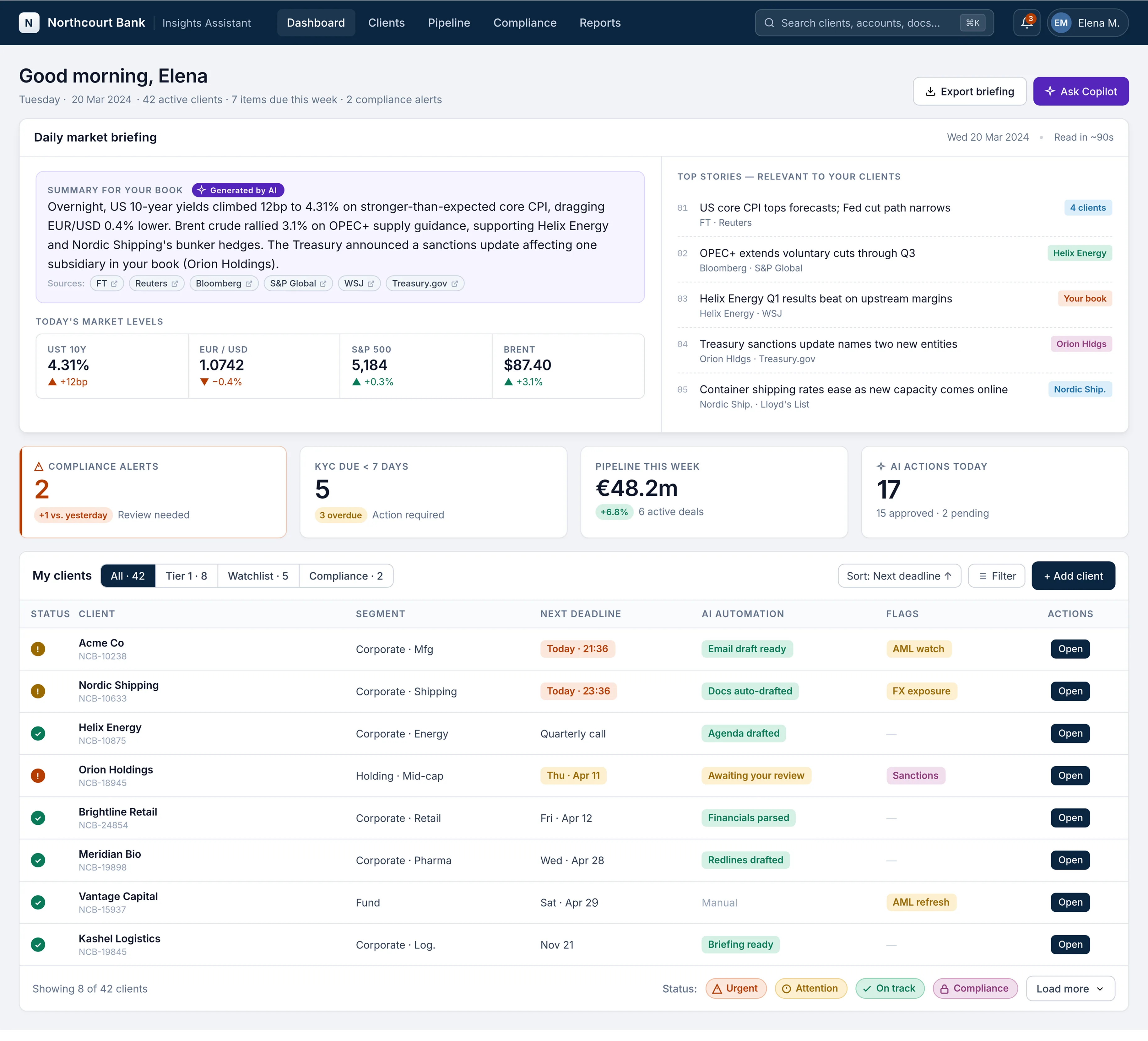
When the project was happening, AI design tools were not as widely available for project work yet. Due to client confidentiality, I'm also limited in how much real project work I can show publicly. So, while building this portfolio website, I took the opportunity to recreate a couple of the designs with AI — to explore new possibilities and showcase what I would produce if the projects were happening today.
Project Summary
I led a comprehensive user research and synthesis initiative for a complex multi-departmental platform, helping a large universal bank uncover strategic opportunities where AI could safely create value for employees. The project identified practical use cases to reduce repetitive manual work, improve efficiency in information-heavy tasks, and better support employees in their daily workflows. It concluded with an initial prototype, prioritised use cases, and a small roadmap to guide future validation and implementation.
Employees were drowning in repetitive, data-intensive busywork
The bank's employees were spending significant time on repetitive, data-intensive tasks such as summarising large volumes of information and manually extracting data from dense documents. This increased cognitive load, created risk of human error and left less time for strategic or customer-impacting work.
Delivering a tool that must be:
- Scalable in the future
- Keeps bank data secure
- Integrates with current infrastructure
- Adheres to regulatory compliance
Data Privacy
Public AI models must not have access to the bank's prompts or data.
Risk Testing
Sufficiently tested and checked for risks native to AI tools.
Safe & Trustworthy
Safe, trustworthy and follows ethical standards.
Explainability
Results are explainable and traceable.
Human in the Loop
Human oversight is maintained throughout all AI-assisted processes.
Accountability
Clear ownership and governance structures in place.
One use case, every team, immediate value
We validated a set of high-impact internal use cases where AI could support employees in their daily work.
Research showed that a one-size-fits-all solution would not work across departments, as each team had slightly different processes, priorities, and operational needs.
This led us to recommend an MVP approach that began with one specific use case shared across all teams, with the greatest potential to save time and deliver impact quickly. This MVP could then later serve as a foundation for more tailored departmental workflows.
The way there
I began with interviews across multiple departments to fully grasp the employees' daily context, the reality of their workflows and the complex environment they were navigating.
Navigating Preconceived Solutions
During interview preparation, there was a strong business drive to accelerate the timeline by immediately presenting a pre-defined solution to users for validation. The challenge was to advocate for foundational discovery, ensuring we fully understood the employees' pain points before exposing them to any specific concept.
Hybrid Interview Structure
To balance the need for unbiased discovery with stakeholder expectations, I proposed a hybrid interview structure. I led each session with open-ended, foundational questions to map the users' true workflows, reserving the final few minutes to present the pre-defined screen. This approach protected the integrity of the research while maintaining crucial stakeholder buy-in.
Talk to the people doing the work
Engaging directly with end-users revealed that the initial project hypothesis, of a one-size-fits-all solution, was only relevant to 50% of the departments. The interviews revealed a mix of universal pain points, as well as department-specific challenges tied to varying compliance rules or the number of clients they managed. The overall verdict was very clear: many of the daily processes were highly time-intensive and prone to quality issues.
Four high-impact opportunities
- Optimised client management
- Streamlined market monitoring
- Human-led, AI-assisted report generation
- Enhanced data extraction & analysis
Employee Dissatisfaction
Routine workflows lacked efficiency and effectiveness. Repetitive, time-consuming tasks such as sifting through large volumes of data took hours out of the employees' days and drove down morale.
Manual Entry Risks
Reliance on manual data entry for client information and reviews imposes significant stress on employees and a heightened probability of costly errors or forgotten tasks.
Fragmented User Needs
There are many departments with very different needs and less overlap than initially assumed.
- Automate repetitive processes. Eliminate the need to perform simple, repetitive tasks.
- AI drafting with human oversight. A productivity accelerator that keeps people in control.
- Free up time for high-value work. Let employees focus on the essential parts of their role and seniority.
- Shift from manual tracking to predictive alerts. Ensure nothing falls through the cracks.
- Increase accuracy of data entry. Reduce error rates from manual handling and free up cognitive load.
- Peace of mind on critical reviews. Make sure important client reviews never get missed.
To translate our research into an actionable strategy we synthesised learnings into three core areas:
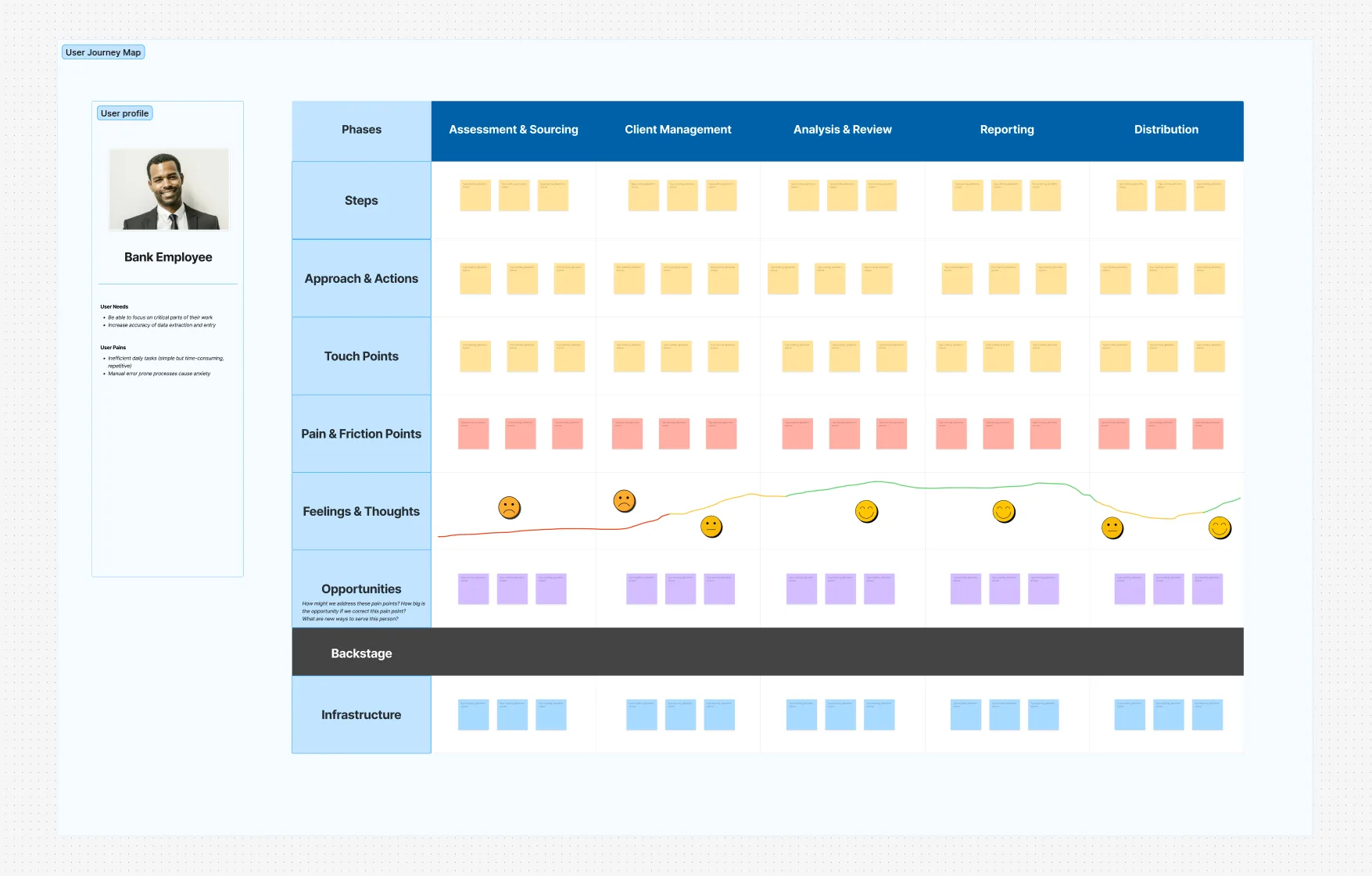
Personas & User Journeys
We mapped the end-to-end current daily reality of our target users to highlight specific friction points.
Process Overlaps
We analysed the workflows to identify where tasks overlapped across different departments, looking for shared opportunities.
Data Source Auditing
We documented exactly where employees pulled their information from, tracking internal and external sources and the steps required to access them.
The Core & the branch
Discovering Divergent Workflows
To validate our findings, I presented the initial user journey map back to the employees for feedback to ensure we had mapped their experience correctly. During these sessions, one department pushed back, pointing out that their specific processes were not accurately represented. After cross-referencing with other teams, we realised some of the workflows didn't overlap nearly as much as our initial interviews suggested, meaning a single, unified journey map wouldn't work.
The Missing User Journey Workshop
While two days of user interviews were enough to identify high-level overlaps between the departments, in this kind of highly complex ecosystem it would have been beneficial to additionally conduct a user journey workshop with all involved departments and define the core journey that is the same for everyone and reveal at which point it needed to branch out in different directions.
For future engagements of this scale, I would advocate for complementing the user interviews with this participatory approach as it would help map varying user needs more efficiently as well as helping the different departments build a shared understanding of each other's needs, priorities and constraints.
Modular Approach
We couldn't build a separate app for every department, nor could we force users down a single funnel if they have varying needs. Our solution was to transition from a linear user journey to a modular, capability-driven setup.
We defined a "Core" journey (applicable to all departments) by deducing the steps they all take and added diverging workflows in the form of departmental modules.
Addressing one specific pain point shared across all departments offered a tangible daily time saving of 1–2 hours per employee while resolving a major point of frustration that was impacting team morale across departments.
This use case became the primary focus of the strategy roadmap, as it showed promise of the biggest user impact and served as a highly scalable MVP solution.
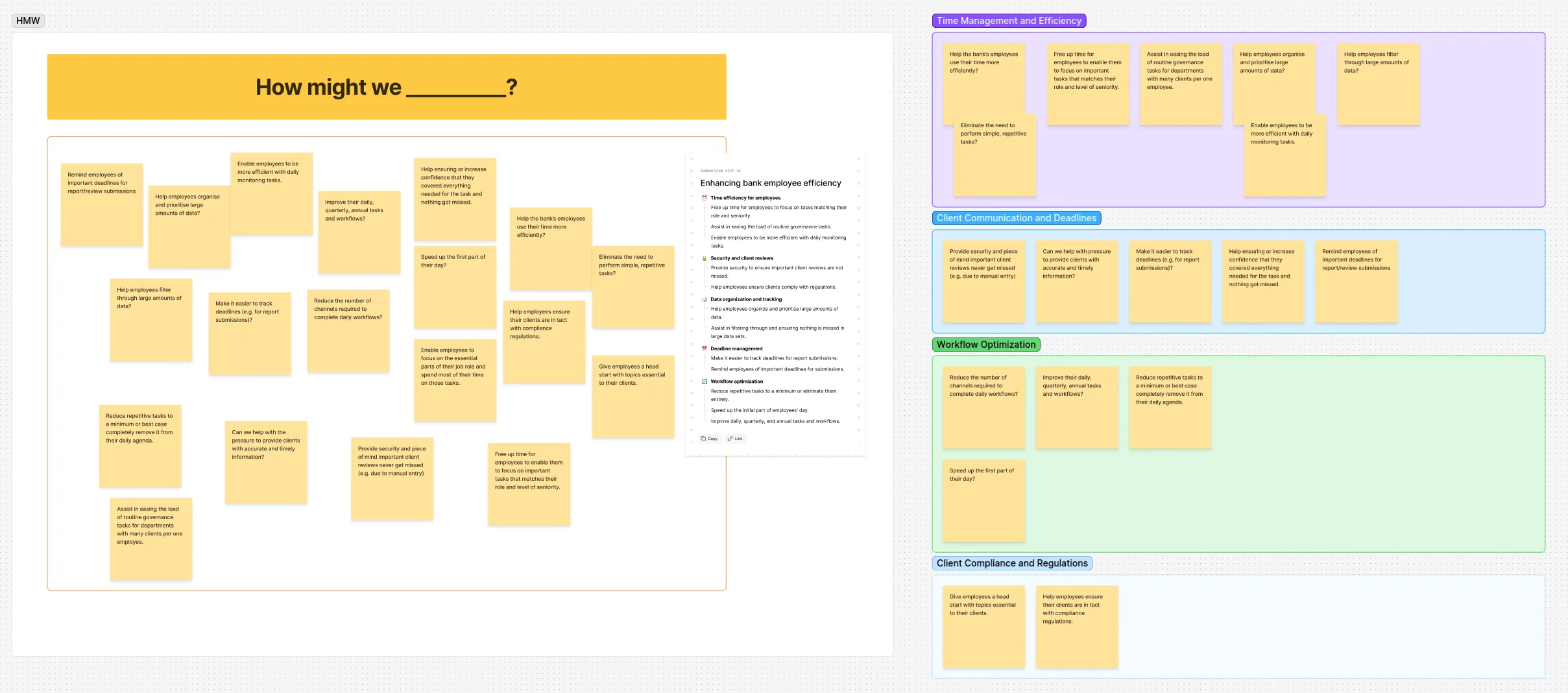
From scattered data points to clustered opportunity areas
A foundation for scalable, AI-driven transformation
The project concluded with setting the foundation for a scalable AI-driven transformation to drive internal efficiency, deliver superior organisational value and minimise operational risk.
We delivered validated use cases and an actionable product strategy and roadmap focussing on creating immediate value by removing manual processes and enabling intelligent data-driven workflows.
A first prototype was drafted to conclude the project and give the client and their employees a first idea of what a solution could look like, enabling them to run first tests internally and explore if the initial pilot would meet employee needs.

My Personal Highlight
Designing for AI in a highly regulated environment required careful consideration of security, reliability and user trust. The project deepened my understanding of how emerging technologies can be shaped through human-centred design to create meaningful, responsible and practical outcomes.